


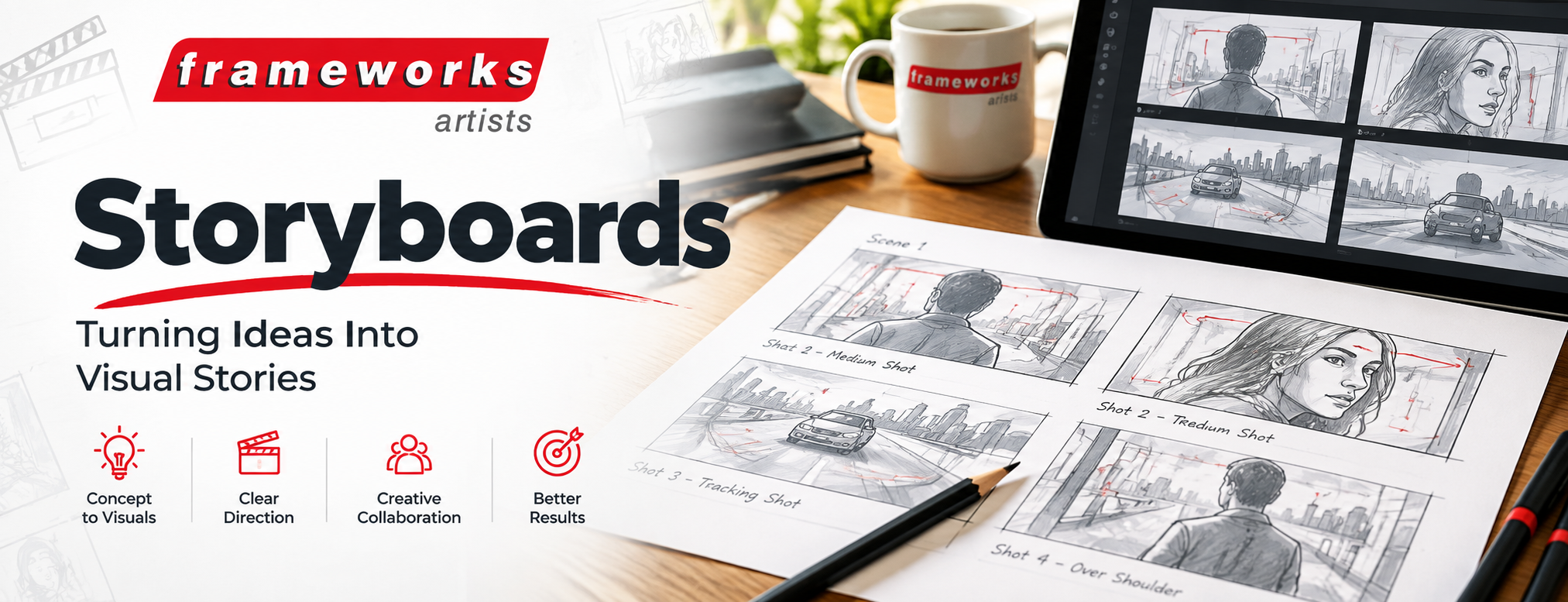
A production rarely becomes expensive because of one obvious mistake. Costs usually start accumulating when problems are discovered after decisions have already been made, equipment has been booked, locations secured, crews assembled, and shooting time allocated.
A camera move may not work in the selected location. A tracking shot may leave no practical path for the rig. An actor’s blocking may interfere with the lighting plan. A product may disappear from frame during a critical camera move. A VFX shot may require plates, tracking data, or additional preparation that was never included in the schedule.
Once these issues surface on set, the available solutions become more expensive. Equipment may need to be repositioned, blocking changed, set elements modified, shots dropped, or additional time added to the schedule.
Storyboards give production teams an opportunity to examine these decisions before filming. By translating a script, treatment, shot list, or director’s vision into sequential images, professional storyboards allow directors, producers, cinematographers, production designers, agencies, and other departments to evaluate how a sequence is intended to work.
The value is not simply visual. A well-developed storyboard becomes a planning document that helps identify production constraints while there is still time to address them.
Why Production Problems Become Expensive on Set
Preproduction allows a team to question and revise a creative decision without disrupting the shoot. Once cameras are rolling, the same change can affect several departments at once.
Changing a camera position can require a new lighting setup. Changing blocking can alter eyelines and continuity. Moving a set element can affect production design. Reworking a shot may create problems with coverage or the planned edit.
This is why visual planning matters.
A storyboard gives the team something specific to examine before physical resources are committed. It allows a proposed sequence to be considered in terms of framing, camera movement, blocking, environment, continuity, and coverage.
It cannot replace location scouting, technical planning, or rehearsals. What it can do is expose questions that those processes need to answer.
1. Storyboards Can Expose Camera Position Problems
A camera position that sounds practical in a script may become difficult when translated into physical space.
Imagine a commercial requiring the camera to move behind a subject, pass between two performers, and finish on a close-up of a product. The creative intention may be clear, but the location could have insufficient clearance for the camera, operator, dolly, track, lighting equipment, or other crew.
A storyboard gives the director and cinematographer a way to examine the intended framing and movement before the shoot.
This is particularly useful when a production involves:
- Tracking or dolly shots
- Crane or overhead movements
- Tight interior locations
- Multiple camera positions
- Complex camera blocking
- Product-focused compositions
- Large practical sets
- Shots requiring significant equipment movement
The storyboard does not establish the final technical setup. It helps identify which setups require closer technical review during scouting and preproduction.
2. Blocking Conflicts Can Be Found Before Filming
Camera placement and performer movement have to work together.
A sequence involving several actors may look straightforward until the intended movement is visualized shot by shot. A character may cross into another actor’s position, a camera may lose access to the action, or furniture and architectural features may restrict movement.
Storyboards can also reveal continuity problems.
If a subject moves from screen left to screen right in one shot and the direction changes unexpectedly in the next, the sequence may become confusing. Inconsistent eyelines can create a similar problem. So can a close-up that requires the camera to move to an impractical side of the action.
A professional Storyboard Artist can visualize these relationships across a sequence, allowing the director and production team to review blocking before it becomes a set problem.
3. Storyboards Help Prevent Missing Coverage
A strong individual frame does not guarantee that a scene will cut together effectively.
One costly discovery can occur in the edit: the production did not capture the coverage needed to build the intended sequence. An establishing shot, master, reaction, insert, detail, or alternate angle may be missing.
Storyboarding encourages the team to evaluate the complete visual progression rather than treating every shot as an isolated image.
Before approving a sequence, the production can ask:
- Does the opening shot establish the geography?
- Is the main action clearly covered?
- Are important reactions included?
- Does the editor have enough options to construct the sequence?
- Is screen direction consistent?
- Are essential product or story details visible?
- Which shots are essential to the concept?
- Which shots provide optional editorial flexibility?
This becomes particularly important in commercial production, where a short runtime can require highly controlled visual storytelling.
4. VFX Requirements Can Be Identified Earlier
VFX can affect production long before an image reaches postproduction.
A shot involving a digital environment, screen replacement, object removal, set extension, compositing, or interaction with a CG element may require specific decisions during filming.
A storyboard can bring those requirements into the conversation.
For example, a camera move may need to provide suitable tracking information. A character may need to interact with an element that will be added later. A clean plate may be required. A planned composition may need to preserve enough information around the subject for the VFX work to be completed successfully.
These decisions can affect camera movement, lighting, set construction, props, performance, shooting plates, and scheduling.
The earlier those dependencies are recognized, the more options the production has for solving them.
5. Production Design Can Be Tested Against the Camera
A set should not only look right. It has to work for the shots being photographed.
A wall may obstruct a planned camera move. A doorway may not provide enough space for equipment. A practical element may fall outside the intended composition. A set may need additional depth because the director wants a particular lens and camera position.
Storyboards allow production designers to see how the environment needs to function from the camera’s perspective.
This is especially useful for custom sets, product environments, period productions, commercials, and scenes involving multiple camera positions.
Instead of designing a space independently from shot planning, the team can evaluate how specific areas of the set support specific shots.
Lighting Problems Can Also Surface During Storyboard Review
Lighting is closely connected to composition and camera movement.
The intended frame can influence where lights can be positioned, where shadows may fall, how much room the crew needs, and whether practical lighting elements need to be incorporated into the environment.
Consider a moving shot through a confined interior. The camera may need to travel through an area where lighting equipment would normally be placed. A product commercial may require consistent reflections across several angles. A close-up may leave very little physical space for lighting fixtures.
A storyboard cannot determine the final lighting setup, but it can flag shots that deserve additional planning.
That gives the cinematographer and production team a chance to address access, equipment placement, continuity, and practical limitations before the shooting day.
Storyboards Help Producers Evaluate Production Complexity
Not every shot deserves the same level of production expenditure.
A storyboard review can help directors and producers compare the creative value of a shot with the resources required to execute it.
A technically demanding shot may justify a complex rig, extensive set modification, additional crew, specialized equipment, or VFX if it is central to the concept. Another complicated shot may offer little additional value compared with a simpler approach.
Storyboards make that discussion concrete.
For advertising agencies and commercial production companies, this can be especially valuable during pitch development and preproduction. A sequence can be evaluated not only for how it looks, but also for how difficult it will be to execute within the available budget and schedule.
The objective is not to make every shot cheaper. It is to identify where production resources are being used intentionally.
Storyboards Give Multiple Departments the Same Visual Reference
A production involves people looking at the same project from different professional perspectives.
The director is concerned with performance and storytelling. The cinematographer is considering framing, lenses, movement, and lighting. The production designer is focused on the environment. The producer is managing budget and schedule. The agency and client may be evaluating whether the visual concept communicates the intended message.
Written descriptions leave room for interpretation.
A storyboard reduces that ambiguity by giving everyone a shared visual reference.
Instead of discussing an abstract camera move, the team can examine a frame and ask whether the composition is achievable, whether the actor is correctly positioned, whether the background supports the shot, or whether a different camera angle would make the sequence more practical.
That can prevent creative misunderstandings from becoming production problems.
Storyboard Reviews Should Be Part of the Preproduction Process
The value of storyboarding does not come from commissioning artwork and placing it in a production folder. The artwork becomes useful when the production team actively reviews it.
For important sequences, the review should consider:
- Camera position: Can the intended framing be achieved in the available space?
- Camera movement: Is there sufficient clearance for the equipment and crew?
- Blocking: Can performers move as intended without interfering with the camera or lighting?
- Coverage: Does the sequence provide enough material for the planned edit?
- Continuity: Are screen direction, eyelines, positions, and visual details consistent?
- Production design: Does the environment support the planned camera angles?
- Lighting: Can the lighting approach work within the physical setup?
- VFX: Does the shot require plates, tracking information, set extensions, or other preparation?
- Budget: Does the creative benefit justify the production resources required?
- Schedule: Can the shot realistically be completed within the available shooting time?
This turns the storyboard into a production checkpoint.
When Professional Storyboarding Provides the Most Value
Storyboards can support many types of productions, but their planning value increases as a sequence becomes more technically or logistically demanding.
They are particularly useful for:
- High-budget commercial campaigns
- Advertising pitches
- Product commercials
- Action sequences
- VFX-heavy productions
- Location-intensive shoots
- Complex camera movements
- Multi-character blocking
- Feature film sequences
- Animation projects
- Custom set productions
- Scenes involving multiple production departments
The more variables a sequence contains, the more useful it becomes to visualize those relationships before the shoot.
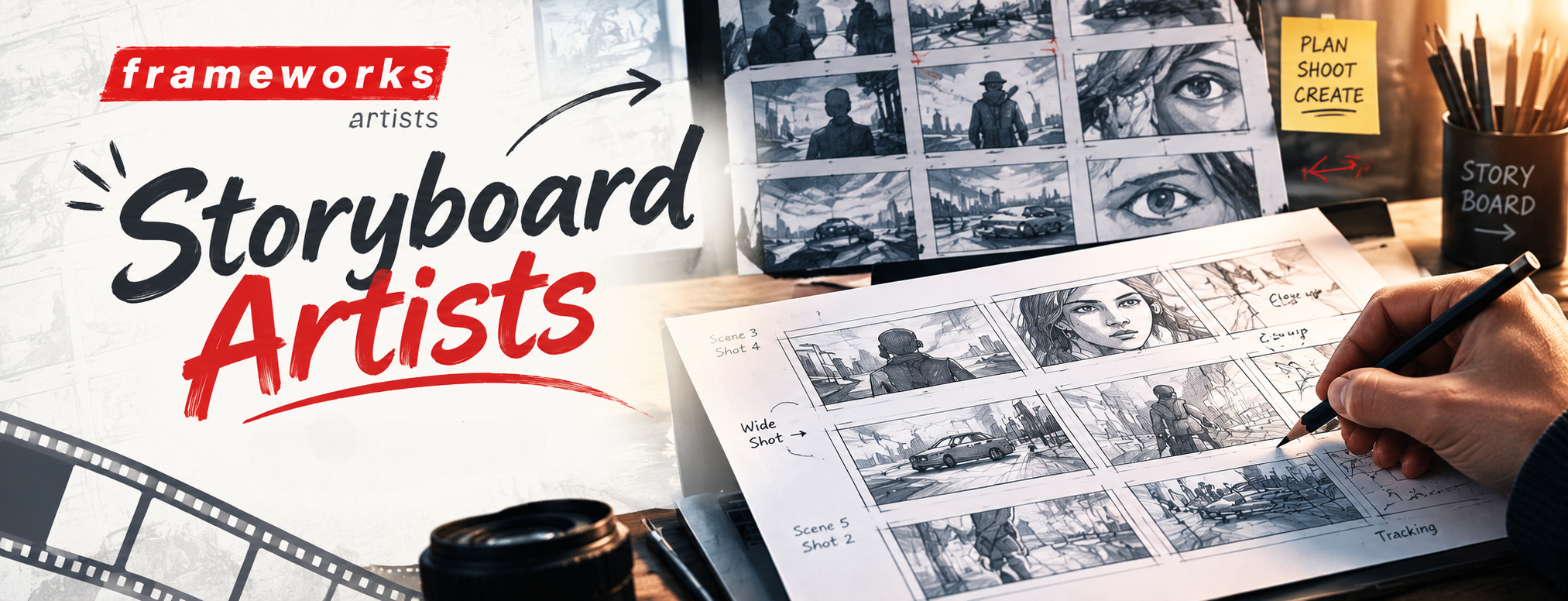
The Right Storyboard Artist Matters
A storyboard is only as useful as the information it communicates.
A professional Storyboard Artist needs to interpret direction accurately while maintaining perspective, composition, camera logic, character positioning, continuity, and the visual priorities of the project.
The appropriate style also depends on the production.
Black-and-white storyboards can provide clear shot planning without adding unnecessary visual treatment. Color storyboards can be valuable when color, lighting, product appearance, wardrobe, environment, or the overall visual direction needs to be communicated more precisely.
The goal is not to create the most elaborate artwork possible. It is to create artwork that answers the production’s visual questions.
For complex projects, Storyboard Artists may work from scripts, treatments, shot lists, director notes, reference images, or rough concepts. Their ability to turn those materials into a coherent sequence can make discussions between creative and production teams considerably more precise.
How Frameworks Artists Supports Preproduction
At Frameworks Artists, we have represented storyboard and preproduction artists since 1996, working with production companies, advertising agencies, television and feature film teams, and other creative professionals across the United States. Our roster includes Black & White Storyboard Artists and Color Storyboard Artists, as well as artists specializing in sketching, comp and concept work, and production design illustration. We can also help clients find artists suited to specific storyboard styles, subject matter, feature projects, and animation work. Because our artists work project by project, we focus on matching the artist to the creative and production requirements rather than applying the same approach to every assignment.
Solve Production Problems Before They Become Production Costs
A production problem is almost always easier to address before the crew is standing on set.
That is the practical value of storyboarding. It gives creative and production teams an opportunity to examine camera placement, movement, blocking, coverage, continuity, production design, lighting, VFX requirements, budget, and scheduling while changes can still be made without disrupting the shoot.
The purpose is not to predict every detail of production. It is to expose decisions that deserve attention before they become expensive to change.
If a camera move will not work, the sequence can be redesigned. If coverage is incomplete, additional shots can be planned. If a set does not support the intended composition, production design can respond. If a technically demanding shot does not justify its cost, the team can consider a more efficient solution.
That makes professional storyboarding an important part of serious preproduction. The earlier a production can see how its creative decisions will interact with physical and technical realities, the more control it has over the final shoot.
Frequently Asked Questions
- How do storyboards help prevent production problems?
They help teams identify issues with camera movement, blocking, coverage, continuity, VFX, and set design before filming begins. - Can storyboards help reduce production costs?
Yes. They can reveal costly production challenges early, giving teams time to adjust shots, equipment, resources, and schedules. - When should a production hire a storyboard artist?
Ideally during preproduction, once the creative direction is developed enough to visualize the planned sequence and shots. - Do storyboards help with VFX planning?
Yes. They can identify shots requiring compositing, clean plates, tracking data, set extensions, or other VFX preparation. - Should I choose a black-and-white or color storyboard artist?
Black-and-white works well for shot planning, while color is useful when visual treatment, lighting, products, wardrobe, or environments need greater detail.