


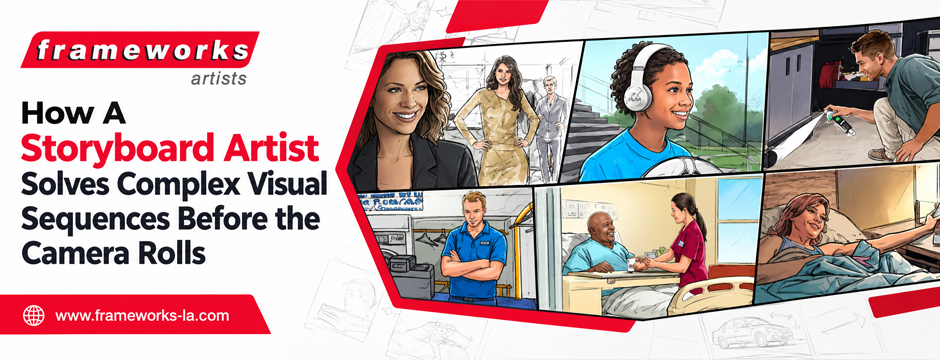
Producing a visually compelling film, commercial, television sequence, or animation involves much more than pointing a camera at a subject and pressing record. Complex scenes often require careful coordination between directors, cinematographers, actors, production designers, stunt teams, and other departments. Before these elements come together on set, a Storyboard Artist helps transform an idea on the page into a sequence of understandable visual moments. By planning compositions, camera positions, movement, transitions, and character actions in advance, storyboarding allows creative teams to identify challenges and refine their approach before production begins.
Turning Written Descriptions Into Visual Decisions
Scripts communicate what happens in a scene, but they do not always explain exactly how every moment should appear on screen. A description such as a character entering a crowded room, moving through a group of people, discovering something unexpected, and reacting to it can involve numerous visual decisions.
Storyboarding breaks that description into individual frames. Each frame represents a specific visual moment and helps the production team understand where characters are positioned, what the camera sees, and how one shot connects to the next.
This process becomes particularly valuable when a sequence contains multiple actions happening in a short period. Instead of relying entirely on verbal explanations, the creative team can study a visual representation of the scene and make decisions based on what is actually being communicated.
Breaking Down Complex Action
Action sequences are among the most challenging scenes to organize because several elements must work together simultaneously. Characters may be running, fighting, driving, falling, or interacting with moving objects while the camera changes position.
A Storyboard Artist approaches these sequences by separating the action into manageable visual beats. The artist considers the beginning, progression, and conclusion of each movement while determining which moments deserve individual shots.
For example, a vehicle chase may involve a wide establishing shot, a vehicle approaching the camera, an interior reaction shot, a close-up of a hand operating the controls, and several changing perspectives of the vehicles in motion. Mapping these moments beforehand helps determine whether the sequence is visually understandable and whether the intended pacing can be achieved.
The storyboard can also reveal unnecessary shots or moments where the action becomes confusing. Adjustments made during this stage are generally easier than attempting to solve the same problems after filming has started.
Planning Camera Movement and Composition
Camera movement can dramatically influence how an audience experiences a scene. Tracking shots, pans, tilts, crane movements, handheld perspectives, and other techniques each create different visual effects. However, complicated camera movement can also introduce logistical challenges.
A storyboard allows filmmakers to consider camera placement and movement before equipment is positioned on set. Frames can show the approximate relationship between the camera, characters, props, and environment. This gives the cinematography team a visual reference when determining how a sequence might be captured.
Composition is equally important. The placement of a character within the frame can communicate isolation, authority, vulnerability, tension, or intimacy. A carefully planned sequence can therefore use framing not merely to record an action but to reinforce the emotional purpose of the scene.
Managing Continuity Across Multiple Shots
Continuity becomes increasingly difficult as the number of shots in a sequence grows. Characters must maintain consistent positions, movements, gestures, and relationships with their surroundings. Objects may need to appear in specific locations, while screen direction and eyelines must remain coherent.
An Artist Storyboard can provide a visual reference for maintaining these relationships from one frame to another. When production teams review the sequence before shooting, they can identify potential continuity problems and clarify how an action should progress between shots.
This is especially useful when scenes are filmed out of chronological order. A visual plan helps departments understand what needs to match when individual shots are captured at different times.
Visualizing Stunts and Safety Requirements
Stunts and physically demanding sequences require particularly detailed preparation. A storyboard can help communicate the intended progression of an action without requiring performers to immediately execute the complete movement.
For a stunt involving a fall, collision, jump, or fight, individual frames can establish the starting position, major movement, point of impact, and final position. This provides a common visual reference for directors, stunt coordinators, camera operators, and performers.
Storyboards do not replace professional safety planning, rehearsals, or technical assessments. Instead, they support communication by showing how the creative intention of the sequence is expected to unfold. Potentially complicated movements can be discussed and modified before they become part of a live production environment.
Coordinating Multiple Production Departments
A complicated scene rarely belongs to one department. Lighting, wardrobe, set design, props, special effects, visual effects, camera, sound, and performance may all influence the final result.
Detailed storyboards can help these departments understand how their individual contributions fit into the overall sequence. A prop that appears prominently in one shot may need to be prepared in advance. A particular background element may need to remain visible from a specific camera angle. Lighting requirements may change as the camera moves through a space.
By giving different teams a shared visual reference, storyboarding can reduce misunderstandings and improve coordination. Instead of interpreting the script independently, departments can work from a more concrete representation of the intended sequence.
Solving Problems Before Production Begins
One of the greatest advantages of storyboarding is its ability to expose problems while they are still relatively easy to solve. A scene may look straightforward in a script but become difficult when camera movement, physical space, character positions, and timing are considered together.
A Storyboard Artist can help identify these issues by visualizing the sequence frame by frame. Perhaps a camera position blocks an important performance. Maybe two characters cannot move through the space as intended. A transition between shots may not communicate the action clearly. Or the number of required setups may make the sequence unnecessarily complicated.
These discoveries allow filmmakers to revise the plan before valuable production time and resources are committed.
Supporting Advertising and Short-Form Production
Storyboarding is not limited to feature films or television. Short-form productions often require even greater visual precision because they have limited time to communicate an idea.
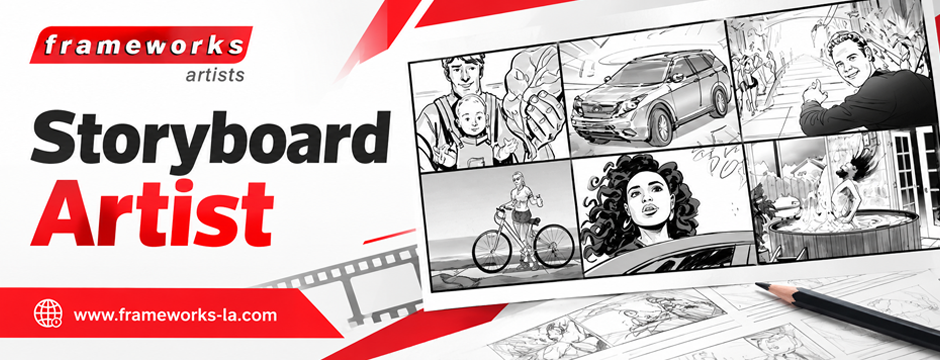
Advertising Storyboards can map out a commercial from its opening image through product interaction, performance, visual transitions, and final branding. Since commercials may combine live action, product photography, visual effects, animation, and carefully timed editing, a visual plan can help the creative team determine how all these components should work together.
The same principle applies to promotional videos, music videos, branded content, and other productions where every second contributes to the final message.
Balancing Creative Ambition With Practical Reality
A storyboard is not simply a collection of attractive drawings. Its practical value comes from its ability to connect creative ambition with production realities.
The visual plan can encourage filmmakers to ask important questions: Is the shot necessary? Can the camera physically reach the intended position? Does the sequence contain enough visual variation? Is the action easy to follow? Will the location support the required movement? Does the transition between shots make sense?
A Storyboard Artist helps make these questions visible during the planning stage. The result is not necessarily a rigid blueprint that cannot change. Instead, it becomes a flexible visual framework that gives the production team a clearer starting point.
Improving Communication Between Director and Crew
Filmmaking involves many creative interpretations. Verbal descriptions can sometimes lead different people to imagine the same scene differently. A storyboard reduces this ambiguity by providing a visual reference that everyone can examine together.
Directors can use frames to communicate their intentions regarding composition, performance, movement, and storytelling. Cinematographers can evaluate potential camera setups. Production teams can understand spatial requirements. Editors can gain insight into the intended progression of the sequence.
This shared understanding can make pre-production discussions more productive and help different departments move toward the same creative objective.
Refining the Sequence Before the Camera Rolls
The most valuable aspect of storyboarding is often the opportunity to experiment. A sequence can be rearranged, simplified, expanded, or completely reconsidered without requiring a camera crew, performers, equipment, or location to be present.
Different approaches can be compared before the final shooting strategy is established. This encourages creative problem-solving and gives filmmakers an opportunity to discover stronger visual solutions.
For complex productions, this preparation can also contribute to better resource management. When the intended shots and movements are understood beforehand, teams can make more informed decisions about equipment, locations, schedules, and personnel.
Frameworks Artists, Inc.: Turning Creative Vision Into Production-Ready Storyboards
Frameworks Artists, connects productions with skilled visual storytellers who understand how to turn complex sequences into clear, compelling storyboards. We offer access to experienced creative professionals across diverse styles and production needs. With us, you can visualize challenging scenes, refine creative direction, and approach every shoot with greater clarity, confidence, and preparation.
Conclusion
Complex visual sequences require careful thought long before the first take. By breaking action into visual beats, planning camera movement, maintaining continuity, supporting stunt preparation, and coordinating multiple departments, a Storyboard Artist helps filmmakers transform complicated ideas into clear and workable visual plans. The process provides an opportunity to discover problems, test creative approaches, and strengthen storytelling before significant production resources are committed. Ultimately, effective storyboarding does more than illustrate what a scene might look like—it creates a practical visual foundation that helps the entire production team understand how the story can come to life on screen.
Frequently Asked Questions
- What does a Storyboard Artist do?
A Storyboard Artist converts scripts and creative concepts into visual sequences that help production teams plan scenes before filming.
- How does storyboarding help with complex scenes?
It breaks complicated action into individual shots, making camera movement, character positions, timing, and transitions easier to understand.
- Why are storyboards important before filming?
They help identify creative and logistical challenges early, reducing confusion and unnecessary changes during production.
- Can storyboards help plan action and stunt sequences?
Yes. They visually map movements, camera angles, and key action beats, supporting better communication during stunt planning and rehearsals.
- How do storyboards help cinematographers?
They provide visual references for framing, camera placement, perspective, movement, and shot transitions.
- Are storyboards useful for advertising productions?
Yes. They help creative teams visualize short, highly structured sequences and ensure each shot supports the intended message.
- When should a storyboard be created?
Ideally, storyboarding takes place during pre-production, allowing the creative and production teams to refine the sequence before the camera rolls.
Tags: Action Sequence Planning, Camera Movement, Commercial Storyboards, Continuity Planning, Creative Production, Film Production, Film Storyboards, Filmmaking, Scene Planning, Storyboard Art, storyboard artwork