


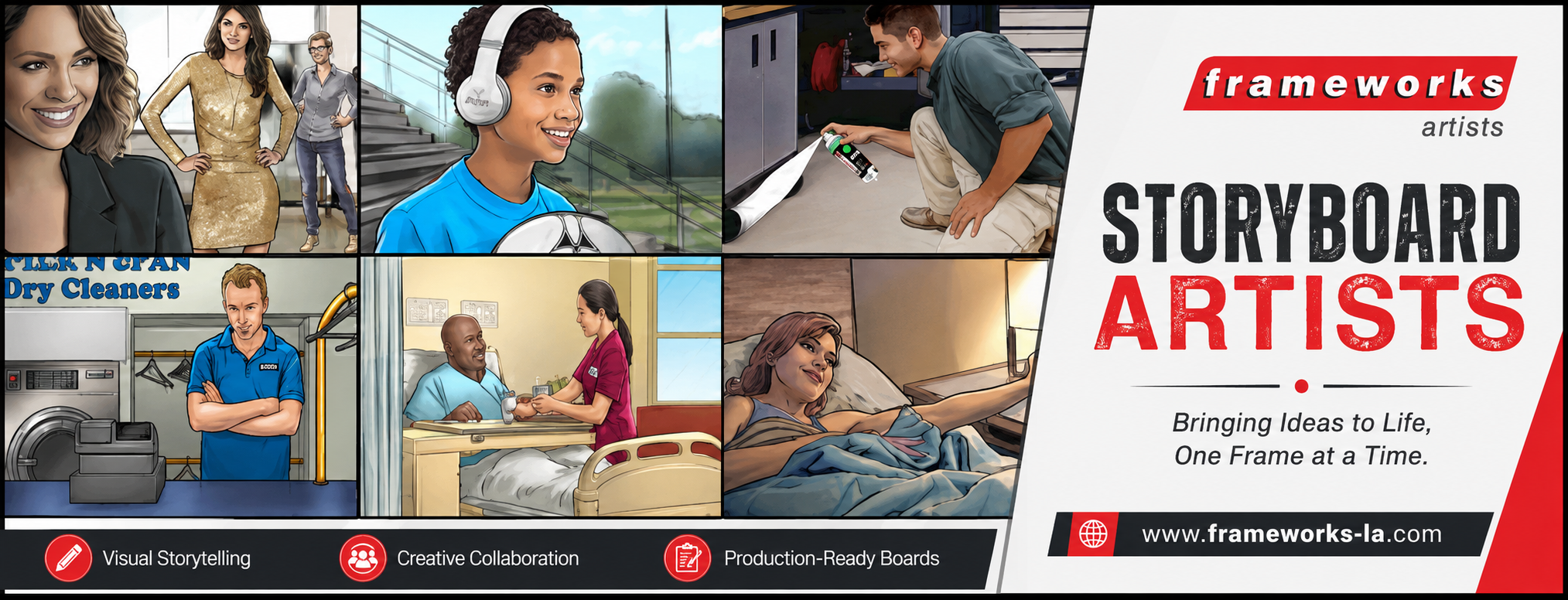
A commercial campaign can move from a written concept to a finished production quickly, leaving little room for uncertainty once the shoot begins. Storyboards give creative and production teams a visual framework for that transition. They can establish shot composition, camera angles, character movement, product placement, pacing, environments, and visual continuity before equipment is on set.
For advertising agencies, choosing the right storyboard artists is therefore more than reviewing attractive drawings. The artist needs to understand the creative brief, interpret a director’s vision, work within production requirements, and communicate visual ideas clearly enough for multiple teams to act on them.
The right selection depends on the type of campaign, the purpose of the boards, the required visual style, the level of detail, the production schedule, and the artist’s experience with similar work.
Start With the Purpose of the Storyboards
Before reviewing artists, determine exactly what the storyboards need to accomplish.
A commercial may require boards for several different reasons. An agency might need presentation boards to sell a concept to a client, detailed production boards to plan a shoot, or a combination of both. These applications can require different approaches to visual detail and presentation.
For a pitch, the boards may need to communicate the campaign’s visual treatment, mood, composition, product presentation, and overall storytelling. The images need to make the creative direction easy for a client to understand.
Production storyboards serve a different function. They may need to communicate specific camera positions, framing, blocking, transitions, action, and shot progression to the director and production crew.
Knowing the purpose first helps an agency identify artists whose portfolios demonstrate the appropriate experience.
Evaluate the Artist’s Commercial Experience
A strong drawing ability is important, but commercial production experience can be equally important.
Advertising projects often involve strict requirements around brand presentation, product visibility, timing, visual continuity, and client approvals. An artist who understands these requirements can interpret a creative idea with greater awareness of how it needs to function in an actual campaign.
Look for portfolio examples involving:
- Television commercials
- Digital advertising campaigns
- Product-focused commercials
- Branded content
- Automotive advertising
- Food and beverage campaigns
- Retail campaigns
- Entertainment advertising
- Agency pitch presentations
Relevant experience does not mean an artist needs to have worked in the exact same industry. What matters is whether the portfolio demonstrates an understanding of commercial storytelling and production requirements.
An artist who has created boards for advertising directors, agencies, or production companies may also be familiar with the review and revision process that commercial projects require.
Review Portfolios for Storytelling, Not Just Drawing Quality
When agencies compare storyboard artists, it is easy to focus on individual frames. A more useful approach is to examine how effectively the artist communicates a sequence.
A storyboard portfolio should show how shots work together.
Review whether the artist can clearly communicate:
- Establishing shots
- Medium and close-up framing
- Camera perspective
- Character blocking
- Product positioning
- Movement and action
- Changes in camera angle
- Transitions between shots
- Visual continuity
- Important environmental details
A visually impressive individual frame does not necessarily indicate strong sequential storytelling.
Advertising storyboards need to make the progression of a commercial understandable. When reviewing a portfolio, consider whether you can follow the action without needing extensive verbal explanation.
Match the Artist’s Style to the Creative Direction
Every commercial has a visual language. The storyboard should support that language rather than work against it.
Some campaigns require highly polished, presentation-ready artwork. Others benefit from simpler black-and-white frames that prioritize composition and production information.
For example, a campaign built around a sophisticated automotive commercial may require detailed environmental and lighting references. A fast-paced comedy spot may place greater emphasis on character action, timing, and camera progression.
An agency should therefore avoid choosing an artist solely because the portfolio looks impressive. Instead, ask whether the artist’s approach fits the project’s creative direction.
Consider factors such as:
- Line quality
- Level of realism
- Character rendering
- Environmental detail
- Perspective
- Lighting representation
- Color treatment
- Composition
- Ability to communicate movement
The strongest portfolio is not necessarily the right portfolio. The right portfolio is the one that demonstrates an approach suitable for the campaign.
Decide Between Color and Black-and-White Storyboards
Color and black-and-white storyboards can serve different purposes.
Color boards can be particularly useful when color is central to the creative treatment. They can communicate product appearance, wardrobe, environments, lighting, atmosphere, and brand-specific visual elements more clearly.
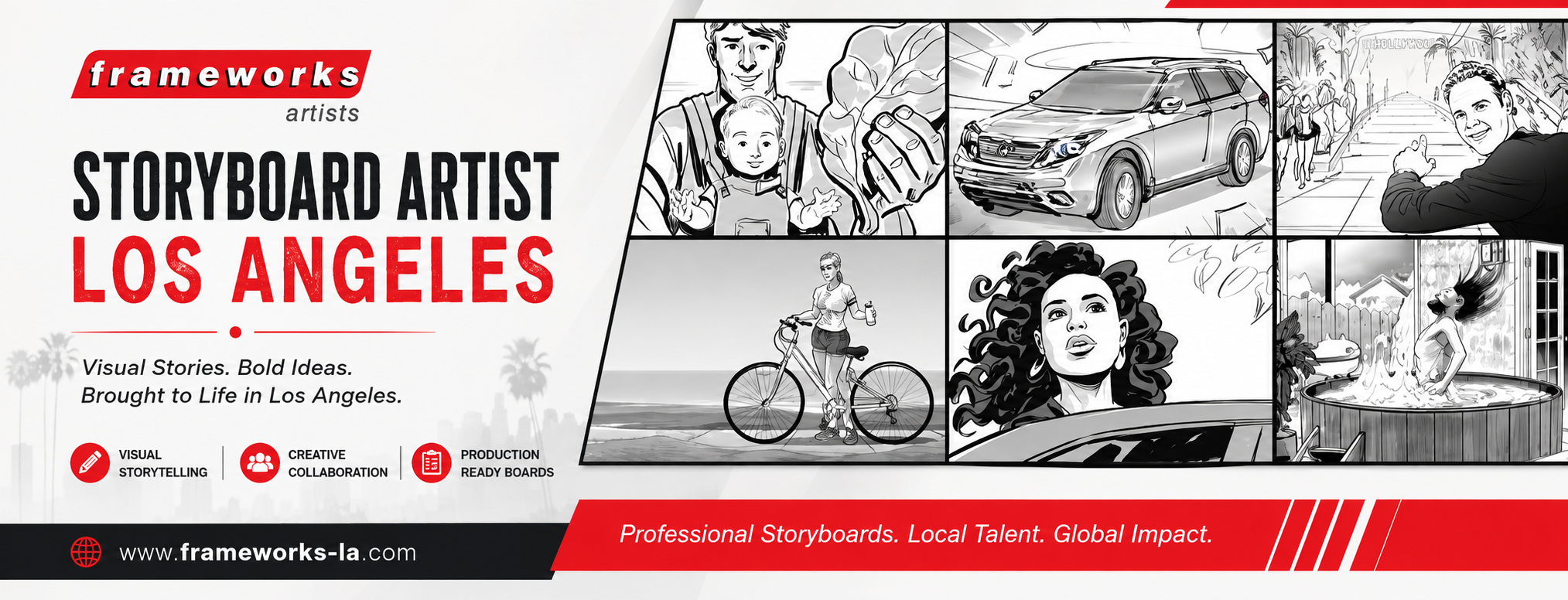
Black-and-white boards can provide an efficient way to communicate framing, action, composition, and shot progression. They can also be appropriate when the production team primarily needs visual planning rather than highly finished presentation artwork.
Neither format is automatically better.
The decision should be based on what the agency, client, director, and production team need to understand from the boards. An experienced artist should be able to recommend an appropriate level of visual treatment based on the project’s purpose.
Consider the Artist’s Understanding of Camera Language
Storyboards are closely connected to cinematography.
A storyboard artist needs to communicate more than what appears in front of the camera. The boards may need to show how a scene is framed and how one shot relates to another.
When reviewing a portfolio, look for evidence that the artist understands visual direction through:
- Shot size
- Camera angle
- Perspective
- Camera movement
- Lens perspective
- Character positioning
- Screen direction
- Composition
- Shot continuity
This is especially important for commercials involving complicated camera movement, multiple characters, product interaction, action, or carefully choreographed sequences.
An artist who understands camera language can make the boards more useful to directors and production teams.
Assess the Ability to Interpret a Creative Brief
An advertising storyboard artists rarely begins with a fully visualized scene. The artist may receive a script, treatment, creative brief, reference images, director notes, or a combination of these materials.
The artist then has to turn those inputs into a coherent sequence of images.
Before hiring, agencies should consider how an artist approaches interpretation.
Can the artist identify the essential visual moments in a script? Can they determine which details need to be shown and which can remain minimal? Can they translate abstract creative direction into concrete images?
This ability matters because a storyboard is not simply an illustrated version of a script. It is a visual planning document.
Consider Revision Requirements
Commercial campaigns frequently go through revisions.
A client may request changes to the product presentation. A creative director may adjust the sequence. A director may change the camera approach. Production requirements may also require alterations before the shoot.
Agencies should therefore ask about the artist’s revision process before assigning a project.
Useful questions include:
- How are revisions handled?
- How many review stages are expected?
- Can individual frames be adjusted without redrawing the entire sequence?
- How quickly can revisions typically be completed?
- What information does the artist need to make revisions efficiently?
The goal is not simply to find an artist who can produce strong first drafts. It is to find someone who can work constructively through the development process.
Consider Schedule and Availability
Commercial production schedules can be demanding. An agency may need boards completed within a short window before a client presentation or production meeting.
Availability should therefore be confirmed before the artist is selected.
Ask about:
- Current project commitments
- Start-date availability
- Expected turnaround
- Revision availability
- Communication during the project
- Delivery format
A highly suitable artist who cannot meet the project’s schedule may not be the appropriate choice for that assignment.
When working with a storyboard artist los angeles agencies should also consider whether the artist’s working arrangements fit the project’s communication and production needs. Location can be useful for projects requiring in-person collaboration, although many storyboard workflows can also accommodate remote communication.
Review the Artist’s Production Workflow
The practical side of storyboard production matters.
Ask how the artist typically receives project information, develops initial frames, handles feedback, and delivers final artwork.
For example, an agency may need:
- Script or treatment review
- Initial visual interpretation
- Rough frame development
- Creative review
- Revisions
- Final storyboard delivery
Understanding this workflow helps the agency establish realistic expectations from the beginning.
It also makes it easier to coordinate the artist with the creative director, director, producer, and client.
Look Beyond Individual Artists When Necessary
An agency may occasionally need several types of visual specialists for a single campaign.
A project could require storyboard artwork alongside concept development, set sketches, or production design illustrations. In these cases, working through established storyboard companies or artist representation agencies can simplify the process of identifying suitable talent.
A professional agency can provide access to different artists and styles without requiring the production team to search individually for every specialist.
This can be particularly useful when deadlines are tight or when the project requires several forms of pre-production artwork.
Understand What a Storyboard Artist Should Receive From the Agency
The quality of the final boards depends partly on the quality of the information provided at the beginning.
An agency should provide as much relevant material as possible, including:
- Final or working script
- Creative brief
- Director’s treatment
- Shot requirements
- Reference imagery
- Product references
- Character descriptions
- Location information
- Brand guidelines
- Visual references
- Client-specific requirements
- Required delivery date
The artist does not need every detail in every project, but clear information reduces unnecessary interpretation and revision.
A well-prepared brief also gives the artist a stronger understanding of what the agency considers most important.
Evaluate Communication and Collaboration
Commercial storyboarding is collaborative work. The artist may interact with agency creatives, directors, producers, production designers, and other members of the project team.
Communication should therefore be part of the selection process.
A good artist should be able to discuss visual decisions clearly, respond to feedback, identify areas that need clarification, and adjust artwork without losing sight of the original creative objective.
The agency should also establish who will provide feedback. Having multiple people send conflicting instructions can create unnecessary revisions and slow down the project.
Clear communication from both sides makes the storyboard process considerably more efficient.
Consider the Level of Detail the Production Requires
More detail is not always more useful.
A production team may need enough information to understand composition, movement, and camera direction without requiring every background element to be fully rendered.
For a client presentation, however, a more developed visual treatment may be necessary to communicate the intended look of the commercial.
The appropriate detail level depends on the purpose of the artwork.
Before hiring, define whether the boards are intended primarily for:
- Creative development
- Client approval
- Agency pitching
- Director planning
- Production planning
- Camera and shot communication
- Visual reference during the shoot
This helps the artist create work that serves a practical purpose instead of simply adding unnecessary visual detail.
Build a Selection Process Around the Actual Campaign
The most effective way to choose a storyboard artist is to evaluate candidates against the requirements of the specific campaign.
Instead of asking, “Who is the strongest artist?” ask:
“Which artist is best suited to communicate this particular commercial?”
Review the campaign’s creative direction, production complexity, schedule, required storyboard format, level of detail, and intended audience for the boards.
Then compare portfolios against those requirements.
This approach produces a more useful shortlist and reduces the risk of choosing an artist based only on general artistic ability.
Working With Frameworks Artists
At Frameworks Artists, we connect advertising agencies, production companies, entertainment businesses, and design teams with professional visual artists for commercial and pre-production projects. Our roster includes color storyboard artists and black-and-white storyboard artists who work on presentation, pitch, and production storyboard projects. We also represent comp and concept artists, set sketchers, and production design illustrators who support broader visual development needs. We work with artists on a non-exclusive, project-by-project basis, giving clients access to different artistic approaches based on the requirements of each assignment. If you need a storyboard artist los angeles agencies can engage for a commercial campaign, we can provide relevant artist samples, discuss rates and availability, and help identify the right creative fit for your project. As an established frameworks agency serving the advertising, entertainment, design, and commercial production industries, we focus on matching each project with artists whose experience and visual approach align with its specific objectives.
Conclusion
Choosing the right storyboard artist for a commercial campaign requires more than reviewing polished artwork. Agencies need to consider the artist’s commercial experience, visual style, understanding of camera language, ability to interpret creative briefs, revision process, availability, communication skills, and suitability for the project’s production requirements.
The right artist should make the campaign easier to visualize and give creative and production teams a practical visual reference before the shoot begins.
A thoughtful selection process starts with the project’s actual needs. Once those requirements are clear, agencies can evaluate portfolios with greater precision and choose storyboard talent that supports both the creative vision and the realities of commercial production.
Frequently Asked Questions
How should an advertising agency choose the right storyboard artist?
Agencies should evaluate an artist’s commercial experience, portfolio style, understanding of camera language, ability to interpret creative briefs, availability, turnaround time, and experience with the type of storyboard required.
Should we hire a color or black-and-white storyboard artist for a commercial?
It depends on the project’s purpose. Color storyboards can be useful for pitches and campaigns where visual treatment, lighting, color, and product presentation are important. Black-and-white storyboards can effectively communicate composition, action, framing, and shot progression for production planning.
What should an agency provide to a storyboard artist before starting a project?
A useful brief can include the script, creative treatment, shot requirements, reference images, product details, character information, locations, visual references, brand guidelines, and project deadline. Clear direction helps the artist develop artwork that aligns with the campaign.
Can Frameworks Artists provide storyboard artists for commercial campaigns?
Yes. Frameworks Artists represents color and black-and-white storyboard artists, along with comp and concept artists, set sketchers, and production design illustrators. We can provide relevant artist samples based on a project’s creative requirements, rates, and availability.
When should an advertising agency bring a storyboard artist into the production process?
A storyboard artist can be brought in during the creative development or pre-production stage, depending on the project’s needs. For pitch work, artists may be involved before client approval. For production storyboards, they can help visualize shots, camera angles, action, and sequencing before the shoot.